• Bhangra discussion is still going strong. Join us in our Facebook group!

    New user registration has been closed (as it was entirely spam). We encourage you to post in our Facebook group, even if it's a followup to an existing thread. BTF will continue to be archived and hosted here - Saleem

Making Saaps

voxanimus

<('.'<) (>'.')>
Messages
1,685
hardeep_singh said:
voxanimus said:
those pieces look really thin man; do you join together two face-to-face to increase the thickness?
thinner = lighter
0.25" is all u need when it comes to plastic
yeah but thinner also = more brittle and less clacking noise
 

hardeep_singh

Well-Known Member
Messages
1,463
voxanimus said:
hardeep_singh said:
voxanimus said:
those pieces look really thin man; do you join together two face-to-face to increase the thickness?
thinner = lighter
0.25" is all u need when it comes to plastic
yeah but thinner also = more brittle and less clacking noise
lol your knowledge of materials science is lacking
 

voxanimus

<('.'<) (>'.')>
Messages
1,685
hardeep_singh said:
voxanimus said:
hardeep_singh said:
voxanimus said:
those pieces look really thin man; do you join together two face-to-face to increase the thickness?
thinner = lighter
0.25" is all u need when it comes to plastic
yeah but thinner also = more brittle and less clacking noise
lol your knowledge of materials science is lacking
not really; with regards to one particular substance, a thicker piece will always be less fragile than a thinner piece. however, i'm not sure of the comparative strengths of wood and whatever plastic composite you used for the saaps.
 

hardeep_singh

Well-Known Member
Messages
1,463
voxanimus said:
hardeep_singh said:
voxanimus said:
hardeep_singh said:
voxanimus said:
those pieces look really thin man; do you join together two face-to-face to increase the thickness?
thinner = lighter
0.25" is all u need when it comes to plastic
yeah but thinner also = more brittle and less clacking noise
lol your knowledge of materials science is lacking
not really; with regards to one particular substance, a thicker piece will always be less fragile than a thinner piece. however, i'm not sure of the comparative strengths of wood and whatever plastic composite you used for the saaps.
first you say brittle then you bring up strength(fragile), i'm not trying to be condescending but you really don't know much about materials science. read up on it if you want better insight, the equations for stress distribution and mechanical properties under different loading circumstances are complicated but the basic ideas are pretty straight forward.

brittleness is a property of chemical composition. you cannot change the brittleness of a material by modifying its physical dimensions. if you're a smartass and you know about machining you'll probably bring up the fact that the properties of a metal piece will change if it's machined(physical dimensions are modified) this is due to heating caused by friction of the machining process, which is why coolant is usually used when machining metal pieces.

clacking noise - every material has a natural frequency, which is a property of its density and chemical structure. vibration due to impact create clacking noise and yes the loudness will change depending on the surface area being impacted. if the surface area is smaller the loudness of the clacking will decrease. like i said previously the frequency of a material is dependent on its density, the density of HDPE(high density polyethylene) is 0.941 g/cc where as most saaps are made out of wood that has densities from 0.6 to 0.8 g/cc, which means that wood will "clack" at a lower frequency than HDPE. HDPE and other types of plastics have a sharper noise than wood. since HDPE has a higher density and a stronger chemical structure than wood, it also deforms less than wood does under similar impacting, physical deformation absorbs impact energy, because HDPE deforms less than wood more of that impact energy is transmitted as vibrations through the material, which leads to louder noise.

a thicker piece is not always less fragile than a thinner piece. everything is dependent on loading(linear, axial, compressive, shear, tensile, torsional) and shape of the piece. none of this is a factor when making saaps because none of the members(pieces) are ever under a load during normal use unless ur opening the saap up and flexing it outwards on purpose. ive stated before a couple of times that saap failures are cause by stress fractures in the wood, usually caused by screw threads rubbing against the holes, which spread along the grain because of deformation caused by repeated impact(this deformation can also have other factors associated because wood deforms due to temperature change and humidity change). which is why i plan on sticking with plastic materials, no grain structure, low deformation due to impact, less susceptible to environmental changes. the impact forces of using a saap are not enough to cause instant failure as long as there are no pre-existing defects.
 

hardeep_singh

Well-Known Member
Messages
1,463


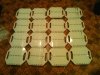
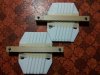
this is the set of saaps i made recently. they were used by MIT at BBC 2011.

they would have been clacked during the sher...but mariam was in attendance
 

ban3rg

Active Member
Messages
1,492
HAHAHAH at "but mariam was in attendance" hahaha and they look sick man. can't wait to see them in action!! maybe MIT will share their perf. if not, good work man, from looking at them and reading about their Clacking properties this Sounds great
 

SEP BCN

New Member
Messages
12
Wow, such a good work!!!

But about the question of voxanimus, I'm also wondering if that white material will sound like the original wood... is it important?
 

HdBrar

Welcome to the Dark Side.
Messages
721
hardeep_singh said:
this is the set of saaps i made recently. they were used by MIT at BBC 2011.

they would have been clacked during the sher...but mariam was in attendance

Yo! You could do SO MUCH customization with those! The possibilities are ENDLESS! IT'S CRAZY! MY MIND HAS BEEN BLOWN! :eek:
 

hardeep_singh

Well-Known Member
Messages
1,463
the first set of plastic saaps i made, were constructed using 1/4" inch thick hdpe plastic because that was what i could get quickly at the moment, so the issue with those saaps is that their flexibility due to the thinness of the pieces makes it difficult to play them. for the latest set of saaps i made, i used 3/8" thick hdpe, which is ideal because the pieces don't flex at that thickness and the saaps still come out lighter than most wooden saaps.


tune in to bhangra idols this saturday to see these saaps in action
http://www.bhangraidols.com/
 

choochoo33

Member
Messages
165
hardeep_singh said:
the first set of plastic saaps i made, were constructed using 1/4" inch thick hdpe plastic because that was what i could get quickly at the moment, so the issue with those saaps is that their flexibility due to the thinness of the pieces makes it difficult to play them. for the latest set of saaps i made, i used 3/8" thick hdpe, which is ideal because the pieces don't flex at that thickness and the saaps still come out lighter than most wooden saaps.


tune in to bhangra idols this saturday to see these saaps in action
http://www.bhangraidols.com/
ahhhhhhhhhhh yeeeea ;)
 

hardeep_singh

Well-Known Member
Messages
1,463
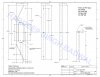
Here is the current 12 inch design, the kind that have recently been used by BK, FS, Xtreme.
Please do not contact me to request a short quantity of saaps, i don't have time to make individual saaps for sale.
Also i'm currently swamped with orders so please refrain from contacting me about large orders until i've posted otherwise.
Please use the attached drawing to make your own. There are a bunch of tricks i've learned along the way but i don't feel like writing a full description of the entire process, sorry.
this is how they look/sound on stage:
https://www.youtube.com/watch?v=W9iJJSL6oZU
Learn. Build. Play your saaps.
 

Attachments

hardeep_singh

Well-Known Member
Messages
1,463
Based on my experience the tools needed are:
Band saw with an adjustable fence and a plastic cutting blade and a decent size table ~$250
Cheapest drill press you can find, seriously the one i have cost $50 at harbor freight
Router table with adjustable fence ~$200

Do not use table saws, even the thinnest blades create too much waste, KICKBACK IS NOT FUN, especially when a table saw shoots plastic at you fast enough to break skin through a t-shirt.
 

kamalb

Gabru Rangeelay -HPDA- Shan-E-Punjab
Messages
34
Haldiholic said:
You should make DIY video of this and put it on youtube, you'd get a lot of hits !


Good stuff !
Its not difficult, like at all. Hardeep has already posted blueprints and told everyone what tools are required. The only thing that you REALLY need if you wanna make your own is time. For the rest, read the blueprints and look at a shikkah lol
 

hardeep_singh

Well-Known Member
Messages
1,463
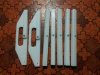
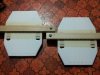
Once you create all the separate parts as shown in the drawing assemble as shown in the images attached.
Step 1: attach the half slats to the handles and the front slats to back slats using screws and nuts
Step 2: Align all the pieces so that they're in the final configuration, use a clamp and tape to hold all the pieces in place
Step 3: drill through the outer holes in the front slats to create the holes in the back slats.
Step 4: use screws, washers, and nuts to complete the assembly process
 

Attachments

Top